Apply for an Education Voucher: Information & Tips for Your Free Continuing Education
Zuletzt bearbeitet am 13. August 2026
Whether you’re looking for a job or already employed, the education voucher is your chance to pursue free professional development or retraining. What many people don’t know is that the Employment Agency or the Job Center covers up to 100% of the costs for professional development. Find out here how to apply for the education voucher, what requirements you need to meet, and how you can use it to completely restart your career.

The Content
- What is an education voucher?
- Who is eligible for the education voucher?
- Maximum Amount of the Education Voucher: What Costs Are Covered?
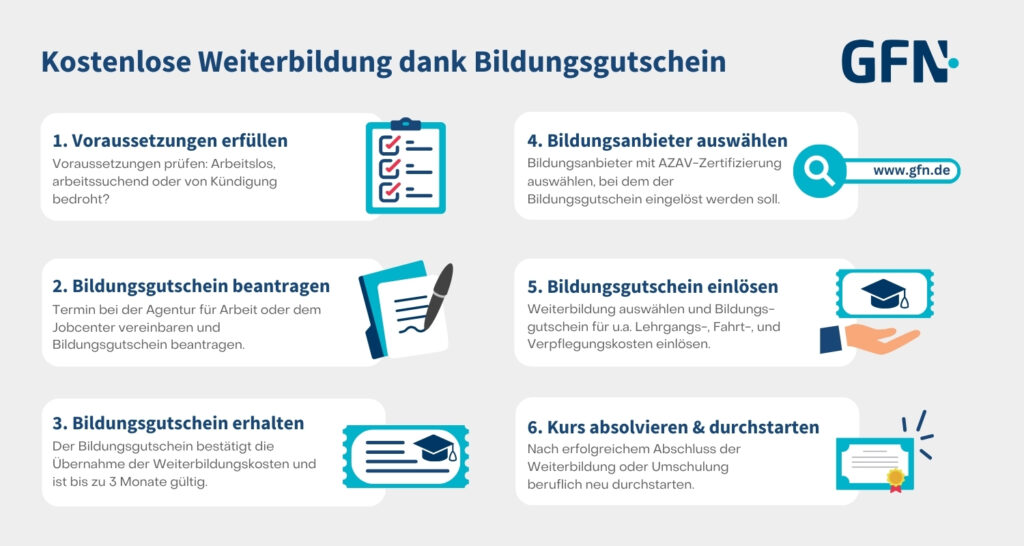
- Here’s how: 3 steps to getting an education voucher
- Eligibility Requirements for Education Vouchers
- Apply for an Education Voucher
- Redeem an Education Voucher
- Retraining or Continuing Education with an Education Voucher
- FAQ – Frequently Asked Questions About the Education Voucher
What is an education voucher?
An education voucher is a document that guarantees that your continuing education or retraining will be funded by the government.
You may be eligible for an education voucher if continuing vocational training could improve your prospects in the job market. The voucher is typically issued by the Employment Agency or the Job Center.
Who is eligible for the education voucher?
The issuance of an education voucher is a discretionary benefit, meaning it is generally at the discretion of the Employment Agency or Job Center responsible for you. You have a good chance of receiving this support if you are unemployed and the continuing education you are seeking is likely to help you find work again.
It’s not just job seekers who can benefit— employees at risk of unemployment can as well. Is your company currently cutting jobs? Is your fixed-term contract about to expire? You should take action now and seek advice from the Job Center or the Employment Agency on funding for continuing education through education vouchers.
Companies can also receive the education voucher if they want to help their employees gain the skills needed to meet the new demands of the digital workplace. In this case, funding is provided under the Qualification Opportunities Act.
Education Voucher for Working Adults
So even if you’re employed, you can still apply for an education voucher. The requirement is that your continuing education or retraining be deemed necessary.
Possible reasons for funding could include:
- Preventing Imminent Unemployment
- Catching Up on a Missing Vocational Degree
- Adapting to new job requirements or technologies
If you’re unsure whether you meet the requirements or how the application process works, we’re here to help. We’d be happy to advise you or your employer on continuing education funding and answer any questions you may have.

Call directly
Mon–Fri 8 a.m.–7 p.m.
Maximum Amount of the Education Voucher: What Costs Are Covered?
Since the costs of continuing education or retraining can vary widely, there is no fixed maximum amount for continuing education funding under the education voucher program. The amount of funding depends on your individual situation.
Generally, the following costs are covered by the education voucher:
- Course Costs: Maximum coverage of the costs for your continuing education or retraining, including the costs for required learning materials, work clothes, exam fees, and any aptitude assessment prior to the continuing education program
- Travel Expenses: Reimbursement of travel expenses to and from the course location if it is not near you
- Housing costs: Coverage of housing expenses if you need to stay elsewhere for the course
- Meal expenses: Assistance with meals during continuing education, if they are not otherwise covered
- Childcare costs: We’ll cover the cost of childcare for your children during class hours, if necessary
There are maximum limits on individual expense reimbursements. It’s best to contact your employment agency or job center for details.
Good to know: If you’re unemployed, you’re covered by health, long-term care, accident, and pension insurance while you’re participating in subsidized continuing education or retraining. In addition to the education voucher, there are other funding opportunities available for job seekers, working professionals, and companies. If you have any questions—feel free to contact us.
What does an education voucher look like?
The education voucher is issued specifically for you. It contains the following information:
- Your Personal Educational Goal
- The duration of the approved continuing education or retraining program
- The region in which the education voucher is valid
- The validity period of the education voucher: 3 months from the date of issuance
Here’s how: 3 steps to getting an education voucher

1. Education Voucher Eligibility: Who is eligible for an education voucher?
You may be granted an education voucher, but you are not guaranteed one. The only exception is if you do not have a vocational degree and now wish to obtain one. In this case, you are legally entitled to receive financial support to earn your vocational degree through retraining.
Essentially, it is crucial that the subsidized continuing education or retraining program helps you find a job or avoid unemployment. To receive an education voucher, one of the following requirements must apply to you:
- You are unemployed (whether or not you are receiving benefits under SGB II or III).
- You’re looking for a job.
- You are at risk of losing your job, for example, because your contract is expiring, you are on short-time work, or you are about to be laid off.
- You’re returning to the workforce after a long break from your job and need further training or retraining to successfully reintegrate into the workforce.
- You need further training or retraining to secure your job.
Whether continuing education or retraining is necessary—and thus whether the requirements for an education voucher are met—is determined based on labor market conditions:
- Is it possible to end unemployment without continuing education or retraining?
- Does continuing education increase the chances of re-entering the workforce after a period of unemployment?
- Is your career goal a profession that’s in high demand?
Good to know: There is no age limit for receiving a training voucher. The key factor is whether the training can improve your career prospects. Retraining is also possible, even if you’re over 50.
2. Apply for an education voucher: At the Employment Agency or the Job Center
To obtain an education voucher, you’ll need to have a personal consultation at the Employment Agency or the Job Center. Schedule an appointment at your regional Employment Agency and get comprehensive advice there.
During this interview, we will determine whether you meet the eligibility requirements for an education voucher. You will discuss your career goals and explain how retraining or continuing education can improve your professional situation and increase your chances in the job market.
Our tip:
Vorbereitung ist alles. Du kannst z. B. im Internet schon passende Kurse für dein Jobziel ausfindig machen. Am besten bringst du zusätzlich Stellenangebote mit, die belegen, dass deine Wunsch-Weiterbildung dich auch wirklich für die Anforderungen im angestrebten Job rüstet. Gerne unterstützen wir dich bei der Vorbereitung auf dein Gespräch und erstellen dir auf Wunsch ein individuelles Weiterbildungsangebot. So gehst du mit konkreten Plänen zu deiner Arbeitsagentur/deinem Jobcenter – deine Ansprechperson dort wird deine Zielstrebigkeit zu schätzen wissen.
3. Redeem Your Education Voucher: Find a Certified Education Provider & Get Started
Did you receive your education voucher? Congratulations! Now it’s up to you to decide which education provider you’d like to use your voucher with. You should do this soon, because your education voucher is generally valid for only 3 months from the date of issue.
It is important that the training provider of your choice is certified under the so-called Accreditation and Approval Ordinance for Employment Promotion (AZAV). You can find certified training providers in the KURSNET database of the Federal Employment Agency.
GFN is AZAV-certified and specializes in retraining and continuing education for the digital workplace. You’ll benefit from a range of subsidized courses designed to specifically prepare you for the new requirements and tasks in the workplace—and maximize your career opportunities.
Found the right training provider? There’s not much left for you to do now: Submit the training voucher—or the portion intended for the training provider—to the provider you’ve chosen. They will then fill it out and send it to your local Employment Agency or Job Center. Then you’re all set to begin your retraining or continuing education.
Retraining or Continuing Education with an Education Voucher
Would you like to use your education voucher to pursue a career in IT or an IT-related field? Or simply equip yourself with in-demand skills for the new world of work? Then GFN is the right choice as an education provider. With us, you’ll have access to a comprehensive range of eligible retraining and continuing education programs that will truly advance your career.
Continuing Education with an Education Voucher
From user courses in Microsoft 365 or SAP® to courses in IT administration and programming, as well as project management certifications and continuing education in online marketing:
With up-to-date IT skills, immediately applicable digital expertise, and in-demand certifications, you’ll set yourself on the path to professional success. In instructor-led courses, you can continue your education from the comfort of your own home.
All IT training courses at GFN are eligible for funding through the education voucher.
Retraining with an Education Voucher
Whether you’re interested in a traditional IT job or a business-related (IT) career, retraining at GFN will give you a strong practical focus and qualifications that are in high demand among employers.
In addition to your recognized vocational degree (IHK), you’ll earn relevant certifications and develop digital skills that will give you a decisive advantage in today’s competitive job market.
All retraining programs at GFN are eligible for funding through the education voucher.
Popular Retraining and Continuing Education Programs at GFN (Selection):
- Retraining Program for IT Specialists in System Integration
- Retraining Program for IT Systems Management Specialists
- Retraining Program for Office Management Specialists
- Continuing Education for Digital Marketing Managers
- Continuing Education Program for Database Specialists
- Microsoft Windows Server Hybrid Administrator Certification
- Scrum Master & Product Owner Certification
- Java Developer Training (OCA)
- Quality Manager with TÜV Certification
- Data Protection Officer with TÜV Certification