Web design & media design training

Get off to a flying start with subsidized training in web and media design.

  • Practical knowledge of digital creative professions
  • Imparting technical & creative know-how
  • Basics in responsive web design & web development
In the web design course, you will also learn the basics of programming and scripting languages.
Webmasters Europe Badge

Our web and media design courses

Tasks & requirements in web and media design

In the field of media design, you will create media content in the areas of print, audio and video, online and multi- or cross-media. Depending on your interests and specialization, you will work on topics such as animation, 3D design, typography, photography, graphic and communication design or even video games and virtual reality design. You edit photos, videos and 3D graphics and prepare images for print and web as well as for presentations, videos or games.

Your main tasks as a media or graphic designer:

  • Creation of print templates
  • Photo editing
  • Creation of graphics, logos and design elements for digital media
  • Further development of corporate identity and corporate design
  • Graphic design of the website
  • Conception of advertising material
  • Creation of presentations

In the field of web design, you are responsible for the look and user-friendliness of a website. Your job is to design web applications for customers or your employer in such a way that they look good and are sensibly organized and structured.

You work with HTML and CSS, but are also familiar with new technologies as well as programming and scripting languages. Of course, you should also be aware of the latest developments in web design – for example, the use of mobile devices such as smartphones and tablets to access websites is becoming increasingly important.

Your main tasks as a web designer:

  • Creation and maintenance of homepages, websites and landing pages
  • Implementation of design elements in web presences
  • Development of layouts for future websites
  • Adaptation of the website display for different end devices
  • Ongoing optimization of the user-friendliness and accessibility of the websites

Ideally, you will have the following qualifications for a future job as a media or web designer:

  • High degree of creativity
  • Enjoy working with media
  • Communicative competence & customer orientation
  • Good PC & Internet user skills
  • good knowledge of English
  • Curiosity & willingness to learn

In our courses, we teach you the specialist and methodological knowledge and, in particular, the practical skills required to implement creative projects. So if you would like to work in a varied professional field and present ideas in a creative and customer-oriented way, you are in good hands in the field of media and web design – we will prepare you optimally for new professional tasks.

This is how we get you ahead

Web design training: The key to a successful digital future

The future is digital, and the technical possibilities are more diverse than ever. Responsive design is becoming increasingly important as more and more users access websites via different devices. This makes it all the more important for the business success of companies and organizations to not only simply present themselves and their products or services on the web, but also to present them in a visually appealing and responsive way.

What counts is the digital experience - in all channels and media. Accordingly, creative minds who can design websites and digital media professionally are in demand.

At GFN, we offer you high-quality training in web and media design. Whether you want to learn web design, deepen your knowledge of web development or learn the basics of HTML & CSS, we have the right course for you. With the education voucher from the Federal Employment Agency, you can take part in your web design training free of charge.
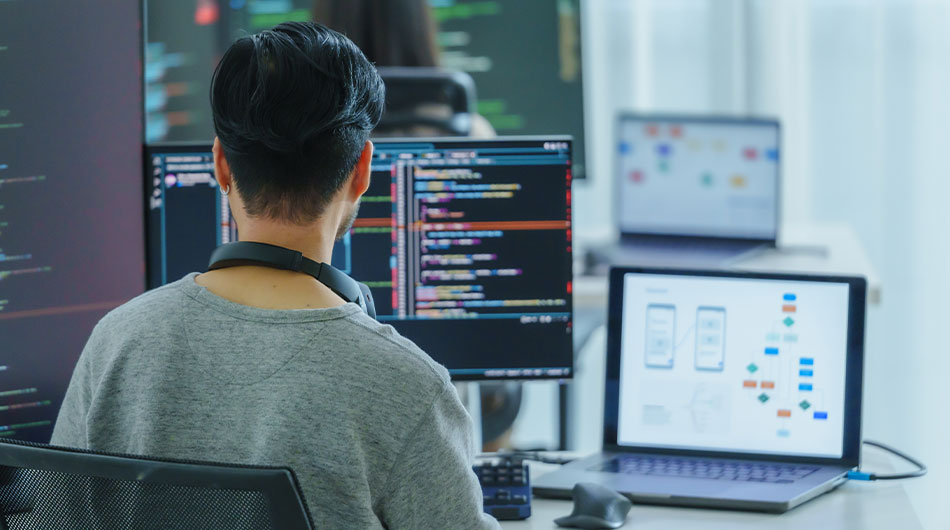
Further training in web design or further training in media design prepares you to keep pace with the constantly growing and changing digital landscape.

Why is further training in web design & media design worthwhile?

The Internet has developed rapidly in recent years. Web designers and media designers are needed wherever there is an online presence - in other words, practically everywhere. More and more companies and public authorities have now understood that a visually appealing website is a key success factor.

The demand for digital creatives is correspondingly high, for example in advertising or web agencies, with software providers or in internal PR and graphics departments.

Further training in web design or further training in media design prepares you to keep pace with the constantly growing and changing digital landscape.

But even if you don't want to go into media and web design full-time right away, you can still score points with web design basics. In online marketing in particular, these additional qualifications will set you apart from the competition on the job market and increase your job and promotion prospects.

Once you have successfully completed your training, you will receive an official certificate confirming your skills in your chosen field.


Web design courses vs. media design courses

Although they are often mentioned together, there are differences between web design and media design. While web design courses focus specifically on the design of websites, media design training also covers other digital media such as videos, graphics and animations.

In the end, it's up to you which direction you want to take: Do you want to learn pure web design or are you looking for a comprehensive media design course? We will be happy to advise you and work with you to find the right course for your job target.

In contrast to web design courses, which focus specifically on the design of websites, media design training also includes other digital media such as videos, graphics and animations.

Get started in the digital world of work in 4 simple steps.

Advice that really helps - see for yourself.
Give me a call, I will be happy to advise you on the subject of software development.

Call directly

Mon-Fri 8-19 o'clock

Give me a call, I will be happy to advise you on the subject of software development.
06221 77 333 77

Book a consultation

fast & non-binding

Choose date

Top-rated advice:

What our participants say.

The web design course was great. I was able to refresh my knowledge and am now really up to date. That gives me self-confidence. I even passed with distinction. And the training at GFN got me the job I was hoping for.

Peter Rozanski

Certified web designer & e-trainer

Do you have questions about your further training in web design & media design? We will be happy to answer them.

You don't need any specific educational or vocational training to work in web design. The most important thing is that you learn the necessary design and technical skills - and this is exactly what you can achieve in a suitable training course.

Many people who work in web design come from very different backgrounds: Some have trained as media designers, others have a background in graphics, marketing or are career changers. If you are creative, have a good eye for design and are willing to get to grips with digital tools and techniques, you have good prerequisites.

Further training in web design provides you with practical knowledge - for example in design, HTML, CSS and responsive design. This allows you to prepare specifically for jobs in the digital sector, even if you previously did something completely different.

This depends on how intensively you are working on the topic and what goal you are pursuing. If you are on a full-time course, for example, you can often learn the basics of web design in just a few weeks. This includes design principles, color theory, typography and initial knowledge of HTML and CSS. Our basic course lasts one month.

If you want to go deeper - for example into responsive design, accessibility or working with content management systems such as WordPress - you will need a little more time. However, many participants reach a good level after just a few months, enabling them to implement their first web projects or apply for entry-level jobs.

It is particularly helpful if you already work practically during the training and develop your own projects. Not only will you learn faster, but you will also be able to directly demonstrate what you have already mastered. In our courses, you will always benefit from a high level of practical relevance and work-related exercises, so that you are immediately ready for the job later on.

In web design, you can work in very different areas - depending on what you specialize in and how deep your knowledge goes. Here are some typical jobs in web design and related fields:

  • SEO or online marketing specialist - you optimize websites for search engines and provide support with digital marketing.
  • Web designer - you design websites, take care of layout, colors, fonts and user-friendliness.
  • UI/UX Designer - you develop digital interfaces that not only look good, but are also easy to use.
  • Frontend developer - you implement designs technically, mostly with HTML, CSS and JavaScript.
  • Content manager - you maintain content on websites, work with CMS systems such as WordPress and ensure good presentation.
  • Graphic designer with a focus on the web - you design visual elements for websites, e.g. banners, icons or social media graphics.

You can find many of these jobs in agencies, at companies with their own marketing department or as a freelancer. Specialists who can think both creatively and technically are particularly in demand.

Web design and web development often work closely together, but are different areas.

As a web designer, you design the appearance and user guidance of a website. You take care of colors, layouts, fonts and the visual structure - in other words, you make sure that the site is appealing and user-friendly.

Web development ensures that the website functions technically. Front-end developers implement the design with code (e.g. with HTML, CSS and JavaScript), while back-end developers take care of the database, server and functions in the background.

In further training in web design, you will primarily learn the design and basic technical aspects. You can then decide whether you would like to delve deeper into development. This is because the tasks often overlap in practice. Especially in smaller teams or as a freelancer, it is a great advantage if you can also carry out tasks that are more in the technical-functional area.

Web design offers very good opportunities for the future, as almost every company today needs a professional online presence. Websites, online stores, apps and digital platforms need to be designed and maintained - and specialists are needed for this.

Web designers who not only design creatively, but also keep an eye on user-friendliness and mobile presentation, are particularly in demand. If you also have knowledge of web development, SEO or content management systems such as WordPress, you can improve your chances even further.

There are also many opportunities as a freelancer or part-time employee. The industry is constantly evolving - with good training in web design, you will be well prepared.

Yes, you can learn and use web design without in-depth programming knowledge. To get started, basic knowledge of HTML and CSS is often enough, which we teach you in our training courses.

Many modern tools and modular systems, such as WordPress, allow you to design websites without having to write code yourself. You work visually and can still achieve professional results.

If you want to learn more about programming later on, you can always expand your knowledge - for example with a programming course at GFN. But you don't need to be afraid of technology to get started in web design - you will be introduced to it step by step.